ABOUT THE PROGRAM
A simple system designed to reduce memorization.
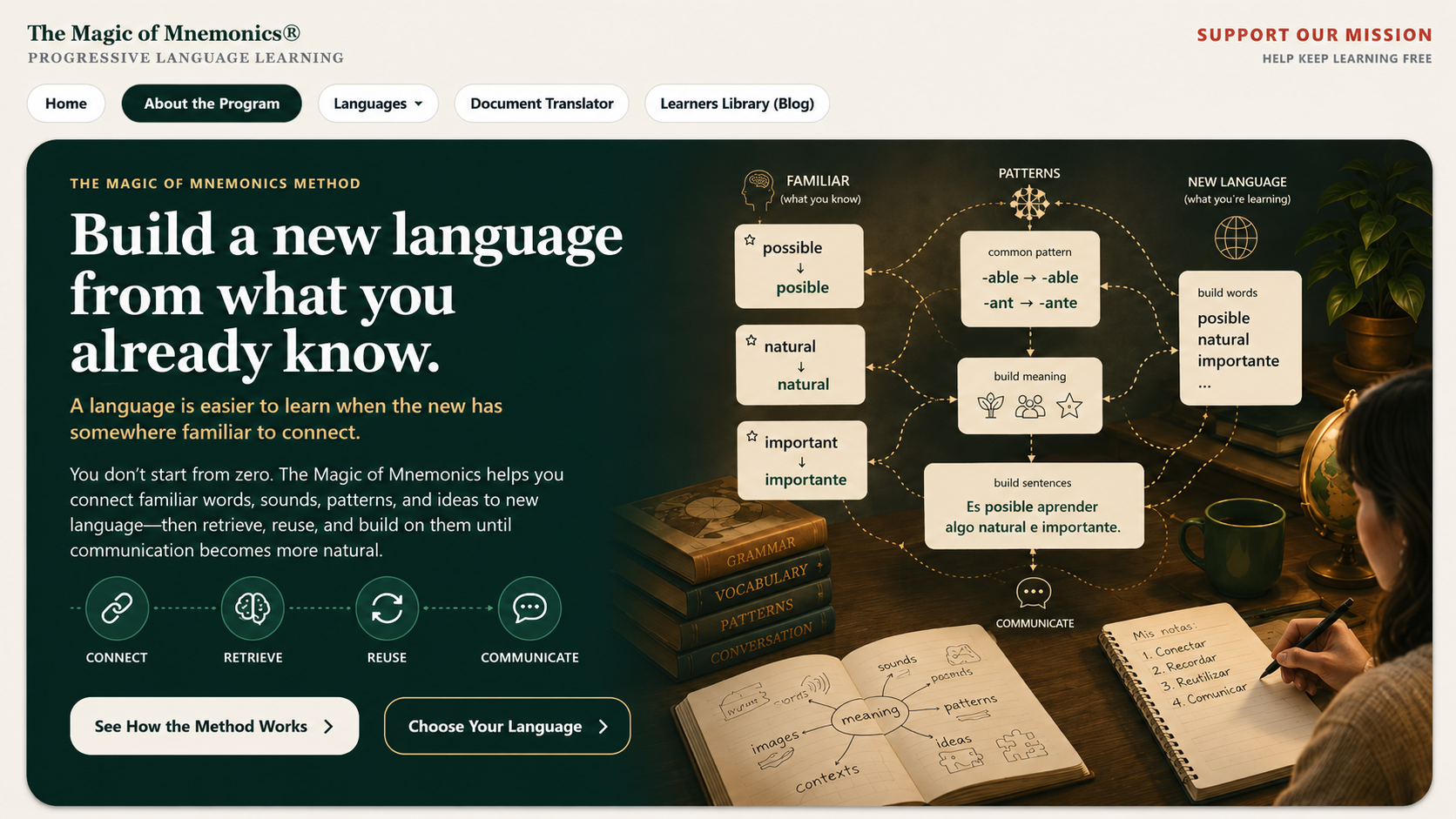
The program does not present hundreds of unrelated words. It begins with useful sentence parts, introduces cognate patterns gradually, and continuously combines new material with what has already been learned.
PRONUNCIATION IS THE KEY
Learn the sounds before depending on memory.
The greatest challenge is often the soundMany English words already resemble Spanish. The main difficulty is not always vocabulary, but recognizing how those words sound when someone speaks.English does not always sound the way it is writtenThe same letter can produce different sounds, and some letters can be silent. Learning these patterns makes comprehension easier from the beginning.The patterns repeatYou do not need to memorize every word separately. Sounds, letter combinations, and word stress appear again and again.Listening becomes easierWhen you understand the main sounds, your brain recognizes familiar words much faster in real conversation.
DISCOVER THOUSANDS OF COGNATES
You already know more than you think.
What is a cognate?A cognate is a word that shares origin, appearance, and meaning in two languages. For example: importante — important, hospital — hospital, and natural — natural.Thousands of words are similarSpanish and English share thousands of words with Latin roots. Many are written almost the same way and retain the same meaning.The major difference is pronunciationThese words may look very familiar, but they are often pronounced differently. That is why cognates and pronunciation should be learned together.Learn rules, not listsPatterns such as -ción → -tion allow you to recognize hundreds of new words without memorizing them one by one.
How learning progresses
1. RecognizeNotice the connection between a familiar Spanish word and its English cognate or pattern.2. BuildCombine familiar words, structures, verbs, nouns, adjectives, and connectors to form useful English.3. RecallThink and retrieve the answer before revealing, listening to, or checking it.4. ReusePreviously learned English returns in later lessons until it becomes familiar and automatic.
WHY THIS METHOD WORKS
Build understanding before memorization.
Language in contextWords are learned inside meaningful phrases and sentences, not as isolated lists.Patterns before pressureCognates and repeated structures help you predict meaning before memorizing everything.Small, successful stepsEach module introduces a manageable amount of new material and combines it with English already learned.Immediate feedbackYou attempt the answer first and then check it while your thinking remains active.
THE FOUR FUNDAMENTAL PRINCIPLES
Read, think, answer, and then reveal.
1. Read before listeningAllow your brain to recognize and interpret the English before hearing the answer.2. Think before revealingMake a genuine attempt. The effort required to retrieve the answer is part of learning.3. Build with known languageConnect every new word or structure to vocabulary, patterns, and sentence parts you already understand.4. Reuse continuouslyUse learned English in new situations to keep it active and prevent forgetting.
HOW YOUR BRAIN LEARNS LANGUAGES
Memory becomes stronger when you retrieve and reuse what you have learned.
Recognition comes firstFamiliar patterns help the brain notice meaning before you can produce the English independently.Recall strengthens memoryTrying to produce an answer before seeing it creates a stronger memory than simply rereading it.Context creates connectionsWords inside useful sentences have more mental connections than words learned separately.Repetition creates automaticityRepeated use in different lessons gradually reduces effort and speeds comprehension.
REFERENCE TOOLS
Use them whenever you need them
These pages support learning but are not numbered modules.